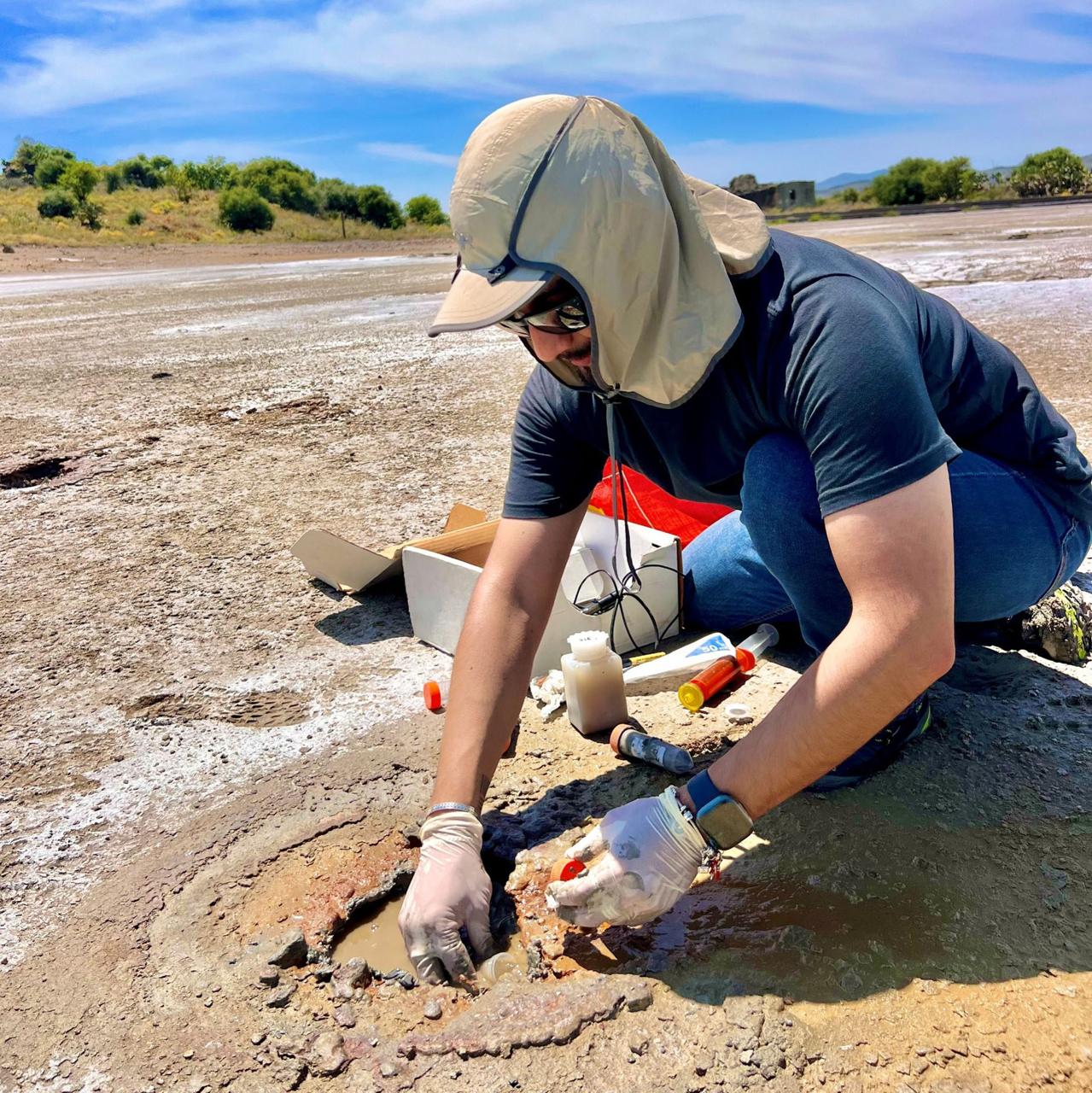
ISME-supported PhD research expands from Chile to Italy, mapping sulfur biochemical cycles of hydrothermal systems to test observed patterns in microbial energy transition in extreme environments.
Why This Research Was Needed
This research represents an expansion of doctoral work that documented temperature-specific points where different microbial survival strategies become equally energy-efficient in Chilean high-altitude hydrothermal systems. These “Energetic Convergence Nodes” occur at 63-64°C, in anoxic conditions between sulfur reduction and methanogenesis routes, marking critical transitions in how microbial communities organize themselves around available energy sources.
The Italian collaboration supported by the ISME Scholar Mobility Fund was essential to test whether these patterns represent broader biological phenomena or site-specific characteristics. The host institution (National Research Council of Italy – Water Research Institute CNR-IRSA, Rome, Italy) specialized expertise in flow cytometry and fluorescence microscopy, combined with advanced DNA extraction protocols, provided the technical capabilities needed for this comparative analysis.
Understanding sulfur biogeochemical cycles across different geological contexts is important because these processes drive chemical transformations affecting mineral formation and biogeochemical cycling. The research examines whether microbial energy transitions follow consistent patterns across different continental locations and geological settings.
Main Research Findings
Through ISME Mobility Fund support, the research processed 27 samples from 9 Italian volcanic hydrothermal sites using advanced DNA sequencing techniques. This analysis maps sulfur biogeochemical cycles and tests whether similar temperature thresholds for metabolic transitions observed in Chilean systems occur in Italian volcanic environments.
Preliminary results suggest sulfur-cycling microbial communities respond to temperature gradients in ways that may support the observed energetic convergence patterns. The research analyzes how microorganisms drive sulfur compound transformations across different thermal zones, building comprehensive datasets for cross-continental comparison.
The study also investigates rare earth element biogeochemistry and biotechnological potential in these extreme systems, expanding understanding of how geological context influences microbial processes and their potential applications.
Scientific and Societal Benefits
This research tests whether the observed microbial energy transitions in Chilean systems occur across different hydrothermal environments. Documenting energetic convergence patterns in Italian systems may establish a framework for predicting microbial behavior in comparable extreme environments.
The work provides foundations for understanding biogeochemical processes in extreme environments, with potential applications in renewable energy through rare earth element studies and biotechnological development. The cross-continental comparison offers insights relevant to understanding early Earth biogeochemical processes and astrobiology research.
The international collaboration strengthens scientific partnerships between Latin American and European institutions, advancing knowledge exchange in geomicrobiology and extreme environment research. The research contributes to understanding biogeochemical processes that operate under conditions analogous to early Earth environments, with applications in environmental management and biotechnology development.
Read more about this research in the publication “Energetic Convergence Drives Metabolic Adaptation in Lirima Chilean High-Altitude Hydrothermal System” by Paquis et al. (2025).
News item author: Pablo Paquis Chester