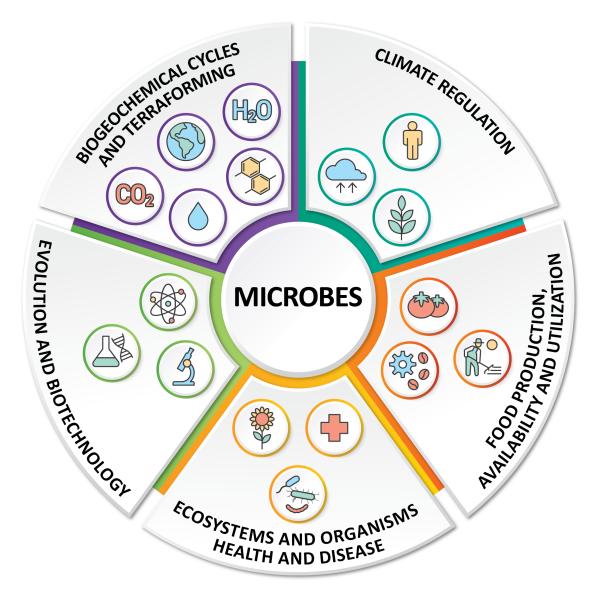
Microbes are the first and dominant life forms on Earth, underpinning climate regulation, ecosystem function, food security, and human health. Despite their essential roles, microbes remain critically underrepresented in global conservation and policy frameworks.
To address this gap, the International Union for Conservation of Nature (IUCN) has established the Microbial Conservation Specialist Group (MCSG) within its Species Survival Commission—the first IUCN body dedicated to the stewardship of microbial life. The MCSG recognizes that without microbes, no conservation goal, from species survival to ecosystem restoration, can be sustainably achieved.
Read the MCSG editorial outlining their action plan for the next 18 months
The group’s mission is to safeguard microbial species and their functions across all ecosystems, acknowledging microbes as the cornerstone of planetary, macrobial species, and human health. Over the next 18 months, the MCSG will implement a strategy built around five core objectives: Assessment, Planning, Action, Networking, and Communication & Policy.
Key initiatives include developing Red List-compatible tools for evaluating microbial communities, creating ethical and practical conservation frameworks, and promoting microbial-based restoration efforts—from coral reef protection and soil regeneration to biobanking microbial diversity. The group will also collaborate with Indigenous communities and international partners to ensure equitable access and benefit-sharing of microbial resources.
Through campaigns such as “Invisible but Indispensable” and “Tiny but Mighty”, the MCSG aims to change the global narrative around microbes—from invisible, undervalued, and irrelevant to indispensable.
By integrating microbial perspectives across IUCN programs and international biodiversity frameworks, the MCSG provides a roadmap to secure the microscopic foundations of life.
We invite microbiologists, ecologists, conservation practitioners, funders, Indigenous and local communities, and policy leaders to read the editorial and join this effort.